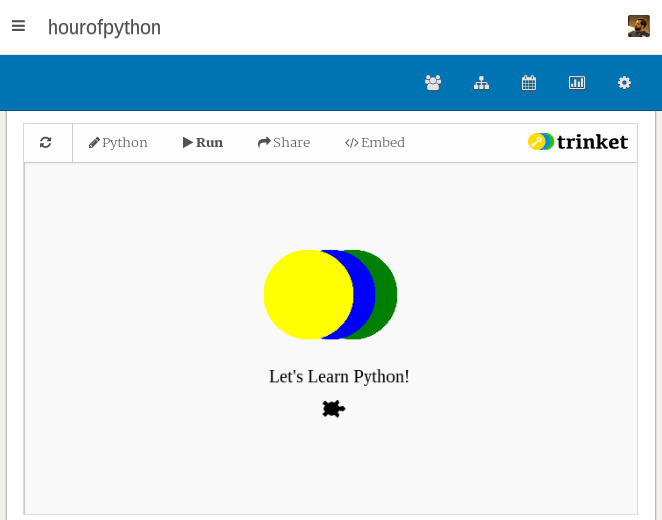
Wikispaces is the most popular wiki provider for education, with over 10 million users worldwide. Trinket lets you make any page into an interactive tool for teaching Programming. Put them together and you have an amazing interactive, student-editable class site.
Just trying out Python? Check our example Hour of Python course on Wikispaces – and feel free to use in your next class! Once you’re ready to customize or make your own, read on for our 3 step guide.
Python has been called a poetic programming language, so I thought why not try writing poetry with it? This is a bit of a departure, but my background in Art History always helps me look for the artistic applications of what we’re doing at Trinket. So here’s a generative poem I wrote in Python. Click Run and see what you get:
Each time you run it you’ll get a different poem. You can edit the lists of words to customize it to be whatever you like.
It’s not an earth-shatteringly great poem. I do think it helps demonstrate how computation isn’t just for computer science. To make the poem better, I’d first start by making lists of different verb tenses and types (transitive/intransitive) and split nouns into subjects and objects to allow for more complex sentence construction. As is, the random spacing juxtaposed with a refrain of sorts gives it a nice rhythm when read aloud. But, like all programs, it’s got to start small and simple.
Others have done much more interesting things than this with computational poetry . I first encountered the work of Nick Montfort during a Natural Language Processing class I took in grad school. His Computational Poems were very inspiring to me. At the time I was just beginning to teach myself to program and seeing through his work what was possible was incredibly motivating.
MIT’s Nick Montfort
At Trinket our mission is to help every teacher teach with hands-on interactive examples in their classroom. Our first Trinkets all involve Python, but we’re seeing very innovative usage of them in other subjects like Math and Physics. If you’re an English or Literature teacher and are or want to use Python in your class, please Tweet me– I’d love to hear what you’re doing and help out if I can!
This is part of a series of occasional interviews I’m doing of educational innovators, both inside and outside the teaching profession. You can find the past interviews here.
We met Elizabeth Wickes at Pycon 2014 and I’m delighted that she agreed to do an interview for us. She’s smart, personable, and passionate about forming community around programming. Her professional career includes working at software company Wolfram Research, but her programming knowledge comes from her own curiosity. Currently a grad student at the University of Illinois at Urbana-Champaign, she’s one of the organizers of the local Python user group. Read on to learn about how she’s made the group into an excellent resource for learning more and experiencing a community.
You may have heard that Trinket has committed over two thousand dollars in matching contributions to Professor Kris Shaffer’s IndieGoGo project to write an interactive, open source Music textbook. As Trinket’s CEO, my job is to build a company that customers love enough to pay money to. As an educator and erstwhile academic, I wholeheartedly support free and open access to educational materials. Can I do both of these things at the same time?
Based on some great feedback and requests on our interactive Python Trinkets, today we’re releasing two Python Trinket features: data visualization and interactive animations. We can’t wait to see how you use these Python charts in class.
Ben Wheeler, our Lead Engineer, is on fire. He built out our new interactive Python charts in just one week. Inspired by Pygal and using the same syntax, you can now create beautiful and simple charts on any web page using data in simple Python lists. As an example of this new feature, check out this pie chart of the most popular coding languages from CodeEval for 2014. By the way, Python has been on top for 3 years running now: